
Clarify Ideas Without Starting a Debate
Anonymous clarification questions help your team understand every idea before it decides.
Running a workshop soon? Book a free facilitator demo and we will set it up with you.
Overview
In every workshop, some ideas make perfect sense to their author and no sense to anyone else. Asking what they mean is awkward and often turns into a debate. This manual explains why unclear ideas lead to poor decisions, and how clarification questions in IdeaClouds help teams understand each other without the social cost.
Why unclear ideas are a hidden problem in workshops
Whether it is a sticky note on a wall, a card on a digital whiteboard or a bullet point in a shared document: whoever writes it down has the context in their head. “Improve onboarding” is crystal clear to its author. Everyone else sees two words and guesses. Researchers call this the curse of knowledge[1]: once you know something, it is hard to imagine what it looks like to someone who does not.
The obvious fix is to ask. In practice, two things get in the way.
Asking has a social cost. Whoever asks “what do you mean by that?” in front of the group admits they did not understand. Many people would rather nod along, especially in mixed groups with managers, external partners or colleagues working in a second language. The research on group idea generation has a name for this fear of being judged, evaluation apprehension[2], and studies it as one of several reasons groups produce less than the same people working alone.
When someone does ask, it turns into a debate. A simple “what do you mean?” quickly becomes “that won’t work here”. The clarification opens the door to evaluation, the loudest voices take over, and the author starts defending the idea instead of explaining it. Even structured methods such as the Nominal Group Technique[3], which has a dedicated clarification step, rely on the facilitator to keep that step from sliding into argument.
The cost shows up later, when the team prioritizes. Everyone rates their own interpretation of a card. A good idea fails because nobody understood it, or two people vote for the same card while meaning completely different things. The result looks like consensus, but it is not.
What a clarification round should do
A good clarification round has one job: make every card understandable before the team decides on it. That leads to a short list of requirements.
- Asking must be safe. Nobody should have to expose themselves to ask.
- A question must not look like criticism. The author should hear it, the whole group should not.
- It must not become a discussion. One question, one reaction, no thread.
- The result must be a better card, not a chat log that nobody reads during the vote.
- It must work when people are not in the room at the same time.
We built clarification questions in IdeaClouds around exactly these rules. The restrictions are the feature: they make it structurally impossible for the round to turn into a debate.
How clarification questions work in IdeaClouds
For the facilitator: open the round
Clarification questions are off by default. When the idea collection is winding down, open the settings of the phase and switch on Allow questions. Every participant gets a short notice that they can now ask about cards they cannot follow, and the phase indicator changes to Clarification round.
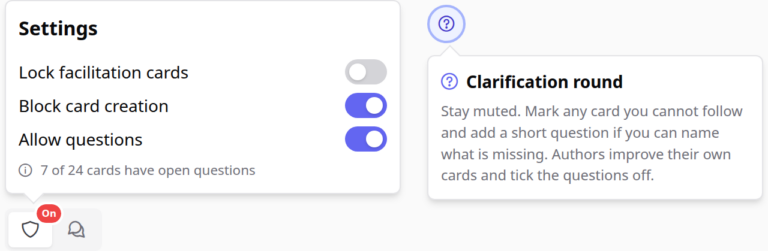
The switch works independently of Block card creation. You can keep collecting ideas while questions are already open, or stop new cards first and then clarify. Both are common, and the choice stays yours.
While the round runs, you see a live counter such as 7 of 24 cards have open questions. You do not see the questions themselves, and nobody sees who asked. The counter is there so you know when the round is done.
Clarification questions are available on the whiteboard and in the column view of a generation phase. They are deliberately not available during evaluation, see below.
For participants: ask, or just mark the card
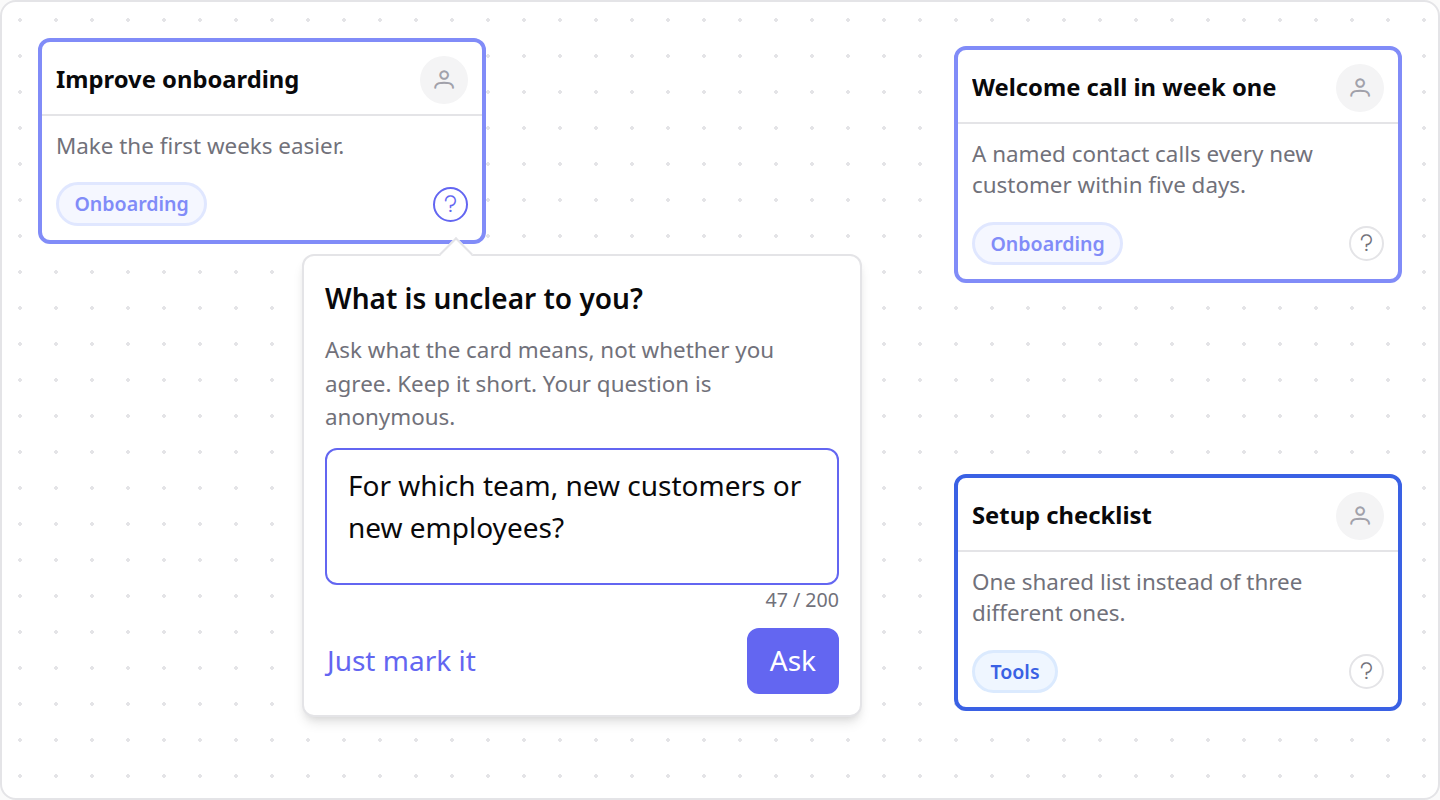
Every card has a small ? in its footer. Click it on a card you cannot follow and you get two options:
- Ask a short question, up to 200 characters. The prompt reminds you to ask what the card means, not whether you agree.
- Just mark it, without writing anything. This is for the moment when you do not understand a card but cannot say exactly what is missing. It takes one click.
Your question is always anonymous, even in sessions where cards themselves show their author. While it is open, you can edit or withdraw it. You ask at most one open question per card, so the author does not receive the same doubt five times from the same person.
For the author: improve the card, then tick the question off
The author is the only person who sees the questions. On their own card, the ? shows how many people asked. Opening it lists the questions, without names.
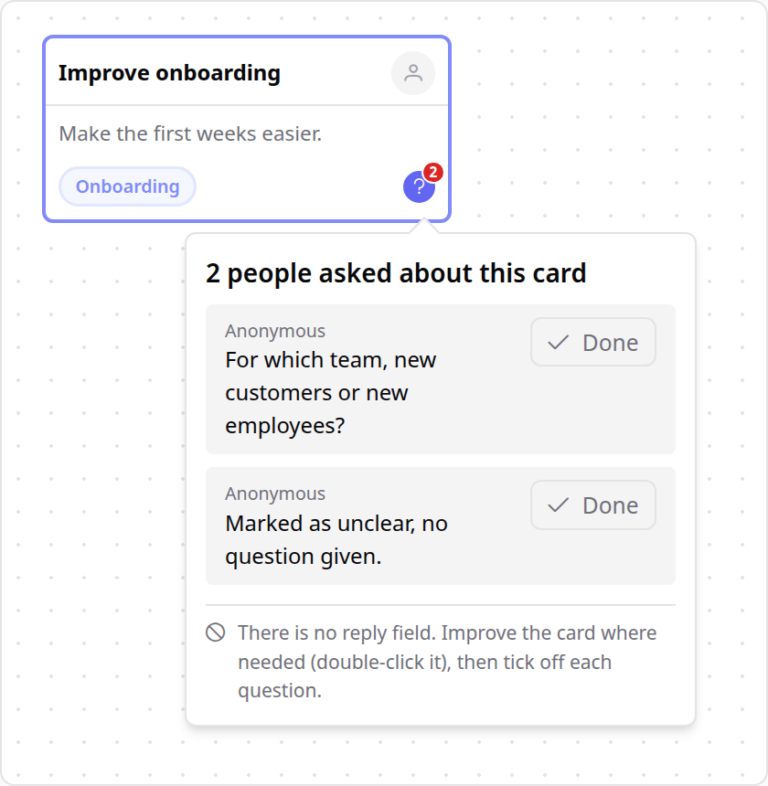
There is no reply field, on purpose. The author answers by improving the card itself: double-click it, sharpen the title or add the missing context, and save. Then tick off each question with Done. Editing alone does not close anything, because authors also edit cards for other reasons, and a question should never disappear just because someone fixed a typo.
The answer everyone benefits from is a better card, not an explanation that only the person who asked gets to read.
For the person who asked: see what changed
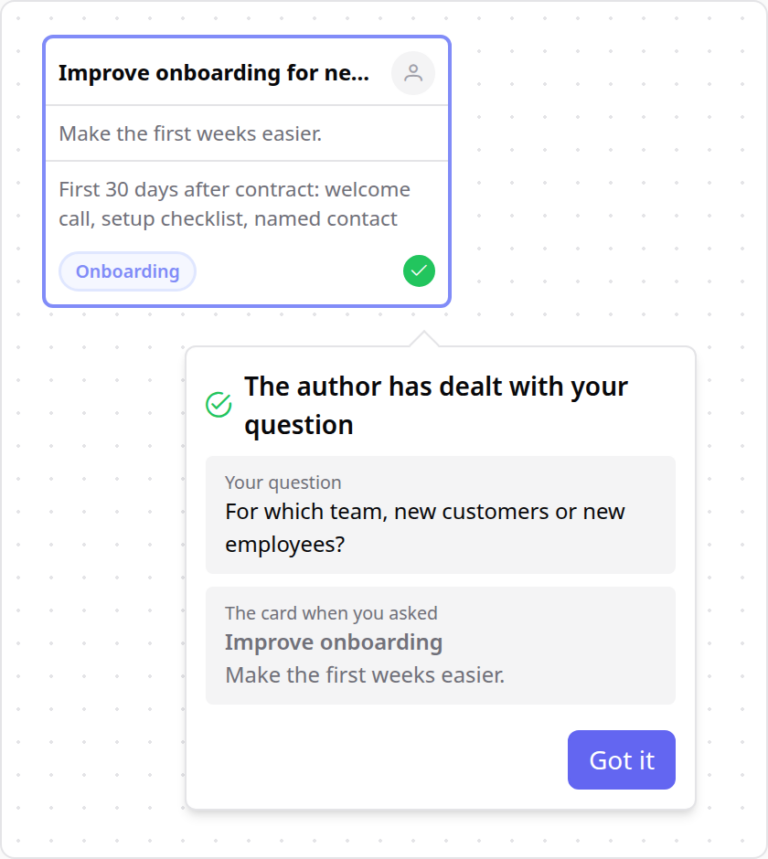
Once the author ticks your question off, your marker changes and the card tells you that the author has dealt with your question. If the card changed since you asked, you also see The card when you asked, so the answer is a before and after rather than a message.
Click Got it and the marker disappears.
When people are not in the session
Many sessions run asynchronously, and people come and go. Questions are stored with the card, so whoever returns later sees exactly the same state as before. Nothing depends on being online at the right moment.
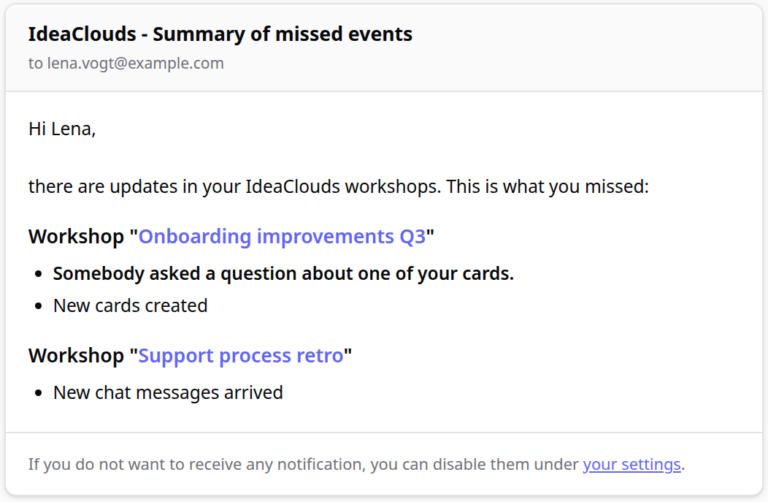
For people who are away, IdeaClouds adds two lines to its digest email: one for authors when someone asked about their card, one for participants when the author has dealt with their question. Neither line contains the card or a name. If a question is dealt with before the digest goes out, its line is removed, so nobody gets mail about work that is already done. Both reminders can be switched off in the notification settings with Somebody asked about my card and My question dealt with.
Where the round stops on purpose
- No comments and no replies to replies. A thread is where debates start.
- No public counter. A visible “five people do not understand this card” would be exactly the criticism in front of the group that the round is designed to avoid.
- No questions during evaluation. Once the team rates cards, the card is what is being measured. If it changed halfway through, earlier ratings would refer to a different text than later ones. Participants who cannot judge a card can abstain for that criterion instead.
- No questions carried into the next phase. Open questions end with the phase. They belong to the version of the card they were asked about.
Practical tips for facilitators
- Open the round near the end of the idea collection. Most cards are written, the authors are still in context, and there is time to improve cards before the evaluation starts.
- Say what the round is for. A single sentence helps: “Mark every card you could not explain to a colleague. Ask what it means, not whether you agree.” The prompt in the dialog repeats this, but hearing it from you sets the tone.
- Encourage marking without a question. Many people hesitate because they cannot phrase the question well. Tell them that a mark is enough. Authors often know exactly what is missing once they see that their card was not clear.
- Keep the room quiet. The point of the round is that clarification happens in writing. If someone starts explaining a card out loud, invite them to improve the card instead, so everyone gets the better version.
- Use the counter to close the round. When the number of cards with open questions stops falling, the round has done its work. Switch off Allow questions and move on to the evaluation.
- Plan for it in asynchronous sessions. If your session runs over several days, open the round a day before the evaluation and mention the email reminders, so authors hear about questions even when they are not logged in.
Ready to run your next clarification round?
Switch on Allow questions in your next session and see how many cards get sharper before the vote. Want to try it with your own topic first? We set it up together with you in a live facilitator demo.
Sources
- Camerer, C., Loewenstein, G., & Weber, M. (1989). The curse of knowledge in economic settings: An experimental analysis. Journal of Political Economy, 97(5), 1232-1254.
- Diehl, M., & Stroebe, W. (1987). Productivity loss in brainstorming groups: Toward the solution of a riddle. Journal of Personality and Social Psychology, 53(3), 497-509.
- Delbecq, A. L., & Van de Ven, A. H. (1971). A group process model for problem identification and program planning. Journal of Applied Behavioral Science, 7(4), 466-492.