
Ideas Evolve. Documentation Doesn't.
Every workshop captures a snapshot. Workshop Evolution captures what happens between them.
Planning a workshop series? Book a free facilitator demo and we will set it up with you.
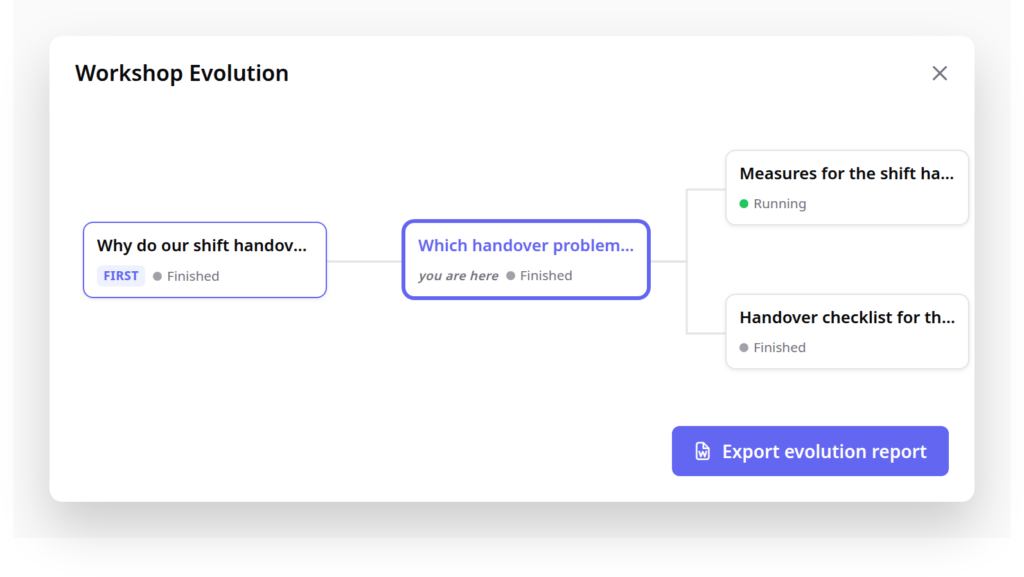
Overview
Most decisions do not happen in one workshop. A round to collect, a round to narrow down, a round to decide what to do. The ideas change on the way: they get sharper, merge, split up or turn into measures. Until now each workshop documented itself, a snapshot of one afternoon, and nothing documented the development between them. Workshop Evolution records that line while you work, shows it in the application, and exports the whole series as one document.
Nothing has to be maintained for this. The connection is recorded at the moment you start a follow-up workshop from your results.
Why a series loses its thread
Two things get lost between workshops, and both only hurt later.
The decision travels, its reasoning does not. Weeks after the last workshop, the measure is in the plan and somebody owns it. Then a new colleague asks why this measure and not another one. The answer was on the whiteboard of the first workshop, in a comparison that took forty minutes and nine people. What survived is the outcome.
Whoever was not in the room never catches up. A series usually outlives its original cast. New team members, the sponsor, a neighbouring department, someone standing in. They receive the result but not the path, so the path gets retold by whoever still remembers it. That person becomes a dependency, and when they change roles the history goes with them.
Starting a follow-up workshop
Select the cards you want to take further and pick a next step at the end of the result page:
- Elaborate cards carries the selection into a new workshop for more detail.
- Evaluate cards carries the selection into a workshop that rates them, usually with different criteria than the first round.
- New workshop starts a workshop without carrying cards, for a topic that came up.
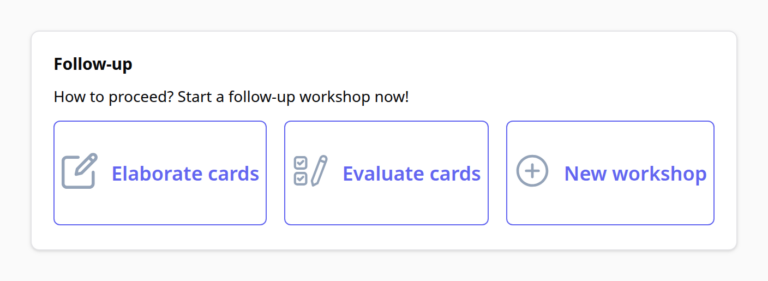
All three create the link back. The new workshop knows which workshop it came from, and every card carried over knows which card it came from. There is no extra step and no field to fill in.
Where a workshop shows its place

The result page of a workshop that belongs to a series carries a strip at the top:
- The outlined chip is where this workshop came from.
- The filled chips are the workshops that came out of it. A green dot means a follow-up is still running, a grey dot means it has finished.
- Whole series opens the map of the entire series.
Workshops you have no access to keep their place in the strip but show no title, so a series never looks shorter than it is.
Finding a series in your workshop list
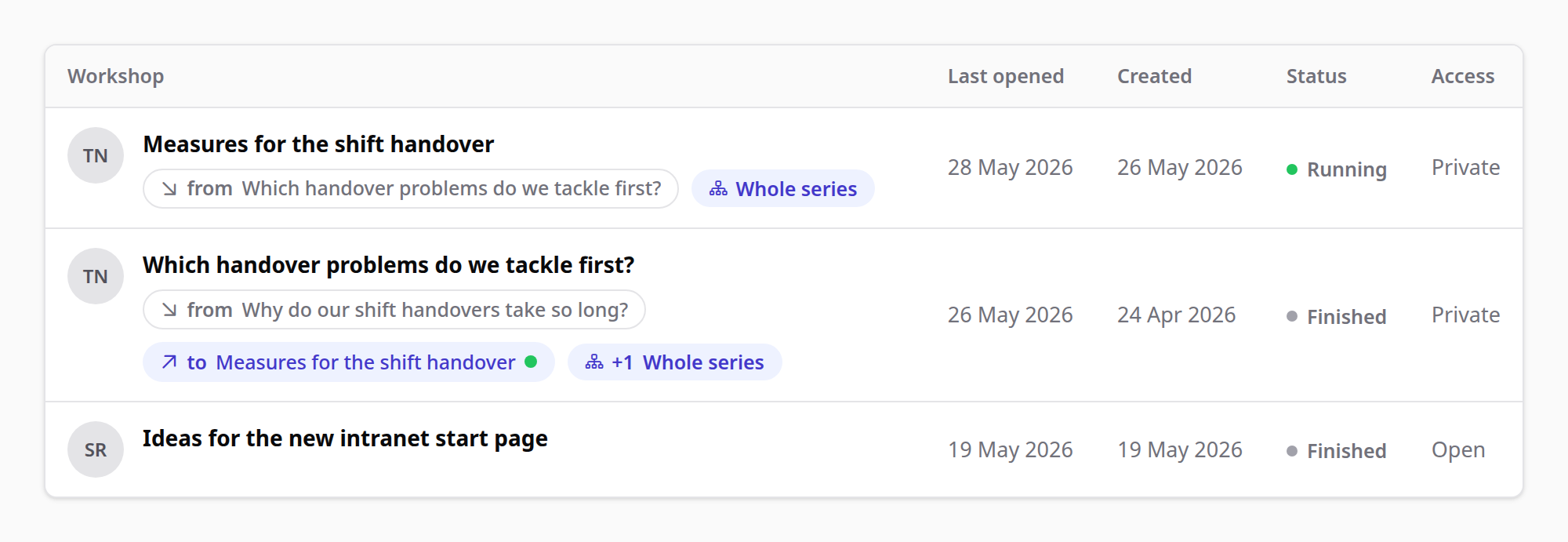
The list stays exactly as it was. Rows that belong to a series carry the same chips underneath the title, so you can see which workshop fed which without opening anything.
When a workshop has more follow-ups than fit in the row, the last chip counts the rest, for example +1 Whole series, and opens the map.
Exporting the evolution report
The map has one action: Export evolution report. It produces a Word document covering the whole series, always with the current state, however many workshops the series has by then.
The series at a glance
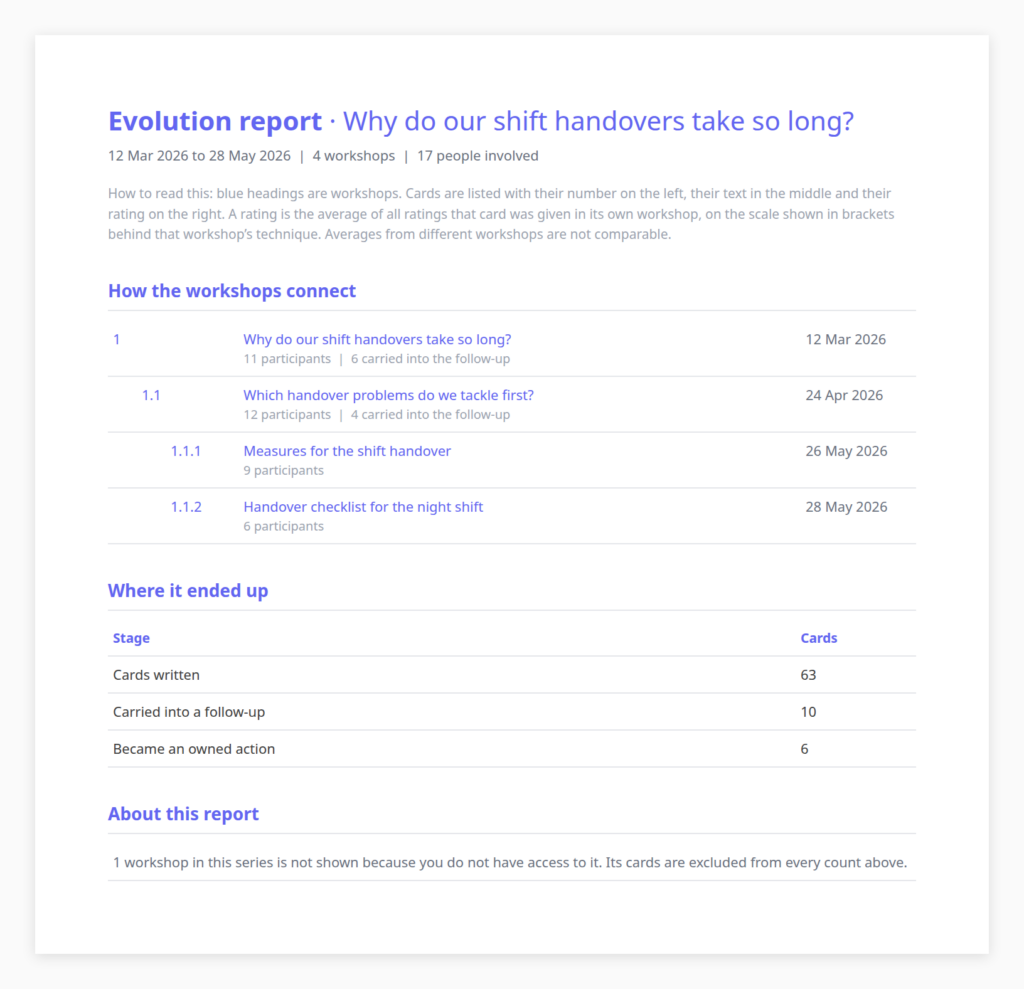
The first page names the series, its period, how many workshops and people were involved, and then answers two questions:
- How the workshops connect. Every workshop with its outline number, in order, indented by branch depth. This numbering is used throughout the document, so you can always tell which workshop a line refers to.
- Where it ended up. How many cards were written across the series, how many were carried into a follow-up and how many became an owned action.
If you have no access to a workshop of the series, the report says so and leaves its cards out of every count.
One block per workshop
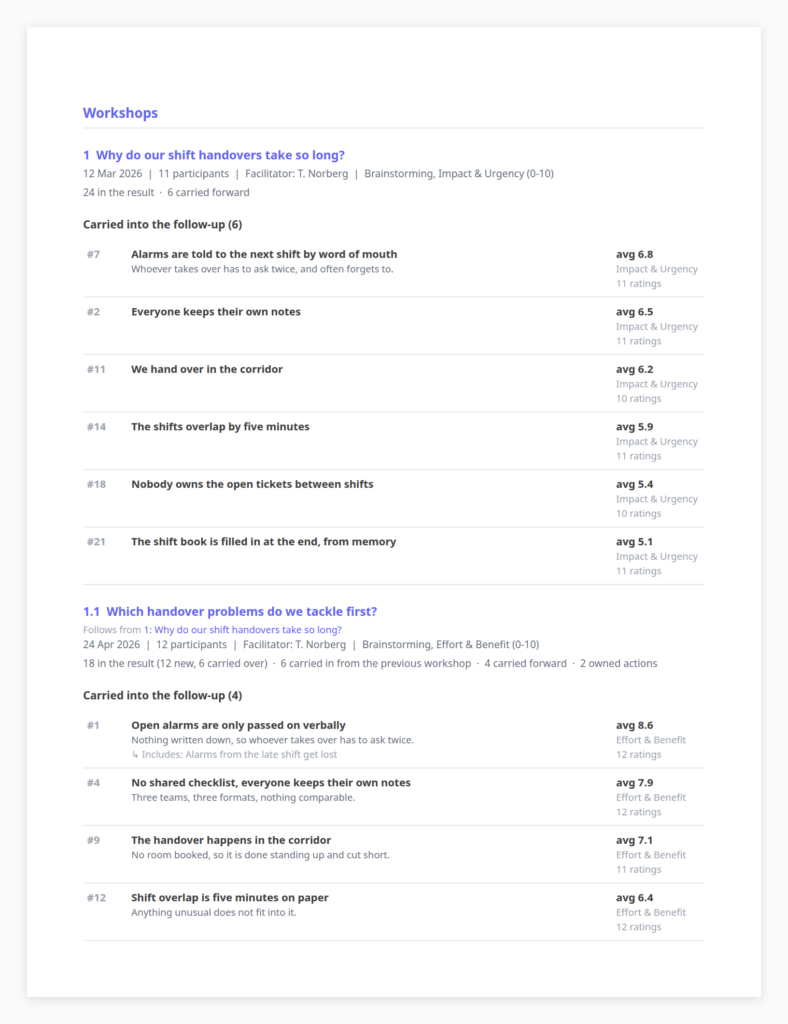
Each workshop gets its own block with its date, its participants, its technique and its rating scale, followed by the cards it handed on. A workshop that has no follow-up shows its results instead, grouped by category, because nothing was passed on from there.
How a card travelled
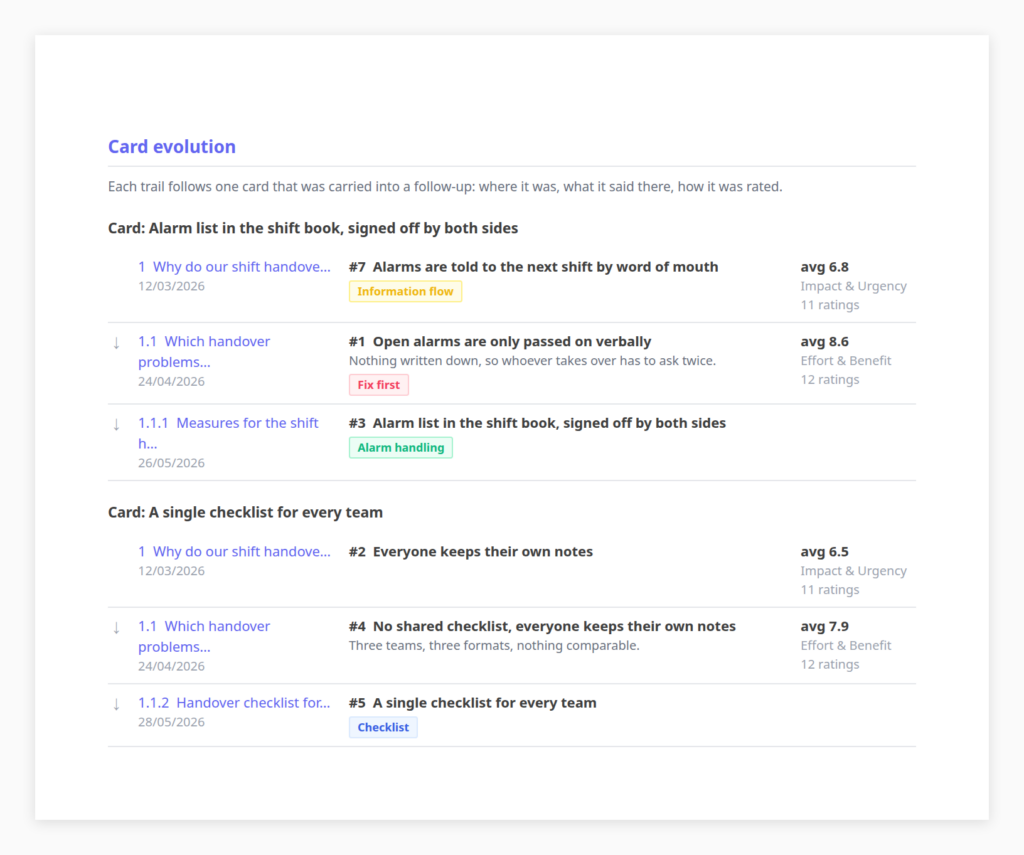
Every card that was carried into a follow-up gets its own trail. One row per workshop the card passed through, reading downwards: the workshop and date on the left, the card as it stood there in the middle, its rating on the right. The heading names the card in its latest wording.
Where a card was merged into another one, the trail says which card its content lives in now, so a merged card never looks abandoned.
Tracking starts when the feature does
Lineage is recorded going forward. Workshops that ran before have no links to show, and a series you started earlier will not gain a history retroactively. The first series you start after the update has a complete one.
Practical tips for facilitators
- Start the follow-up from the result page, not from the dashboard. A workshop created from scratch is a new start, not a follow-up, and nothing connects it to what came before.
- Carry cards over even when you plan to rewrite them. The trail follows the carried card, so a card that was rewritten in the follow-up still shows where it came from. A card typed in fresh starts without a history.
- Name your workshops so they read as a series. The report and the map show topics, not numbers, and “Measures for the shift handover” tells a later reader far more than “Workshop 3”.
- Export the report at the end of the series, not after every workshop. It covers the whole series each time, so the last export is the one worth filing.
- Do not compare ratings across workshops. Each round rates against its own criteria, so an average from one workshop is not comparable to an average from another. The report labels every rating with its criteria for exactly this reason.
Ready to follow your next series?
Run your next follow-up straight from the result page, and the series documents itself. Want to plan a series with us first? We set it up together in a live facilitator demo.